Your Back-to-School Return Policy Is a Conversion Lever
Back-to-school 2026 shopping runs online and starts in June. Here's why your back-to-school return policy decides whether parents buy shoes and apparel from you.

Online is the leading back-to-school destination, and it is where the fit risk lives
Families with K-12 students plan to spend an average of $863.86 this year, pushing total back-to-school spending to a record $43.3 billion, while back-to-college spending crosses $100 billion for the first time at $103.5 billion, according to the National Retail Federation's 2026 back-to-school survey. Online is the single most popular destination in both segments: 50% for K-12 shoppers and 41% for back-to-college shoppers, ahead of department stores, discount stores and clothing stores.
Here is the part that should change how you think about your back-to-school return policy. Two of the four biggest K-12 categories are things a kid has to physically fit into: clothing and accessories at $250.29 per student and shoes at $174.01 per student. Those items are being bought, in huge volume, by parents who cannot put them on the child before checkout.
That is the whole game this season. You are not competing with the store down the road on price. You are competing with the certainty a parent gets from standing in an aisle and watching their kid walk five steps in a shoe. A clear, exchange-friendly return policy is the closest thing you have to replacing that certainty.
The purchase window opened in June and it is still open
Back-to-school stopped being a frantic August weekend. NRF found that about one-third of back-to-school shoppers had already started browsing and buying by early June, the highest share since NRF first asked the question in 2018. By early July, 62% had started, and 54% specifically shopped June promotional events like Prime Day, Walmart Deals and Target Circle Deal Days for school items.
Bizrate Insights, surveying 538 US back-to-school shoppers in May 2026, puts 75% of shoppers starting before August, with July as the peak buying month at 40% of activity and August accounting for a 25% last-mile rush.
A longer season is good news and bad news at once. The good news: you have months of consideration rather than a two-week sprint. The bad news: a shoe bought during a June sale for a September start date has an enormous gap between purchase and first wear. Kids grow. Uniform lists change. Dorm assignments shift. A 30-day return window that starts at delivery quietly expires before the product is ever used.
PwC's 2026 back-to-school poll found that 71% of families complete their purchases between two weeks and two months before the first bell, and that in-store shopping intent fell nine points in a single season, from 79% to 70%, while 67% of parents shop major online marketplaces and 49% buy directly from brand or retailer sites.
If you sell apparel, footwear, backpacks or dorm goods, your policy has to survive a purchase-to-wear gap measured in weeks, not days.
Back-to-school is a sizing category, and sizing categories return
The baseline is already high. The NRF and Happy Returns 2025 Retail Returns Landscape report put the ecommerce return rate at 19.3% of online sales, against 15.8% across all of retail. Roughly one in five online orders comes back.
Category benchmarks compiled from that data put apparel at 20% to 40% and footwear at 17% to 30%. Back-to-school concentrates exactly those two categories into a six-week window.
Bracketing makes it worse. The same NRF and Happy Returns research found 23% of all purchases include a bracketed item, rising to 26% in apparel and footwear. A parent ordering two sizes of the same sneaker is not being difficult; they are doing the only rational thing available when the alternative is a wrong-size shoe on the first day of school. We wrote about how to handle that pattern in turning bracketing and multi-item returns into exchanges.
Shopify's own back-to-school retail guidance makes the seasonal version of the point plainly: back-to-school purchases often happen before students know the exact requirements, which creates higher return rates than normal, and the answer is exchange programs for sizing issues rather than blanket refunds.
So the return is coming. The only decision left is whether it leaves as a refund or comes back as an exchange.
What a back-to-school return policy needs to say
Most policies fail not because they are stingy but because they are vague. A parent scanning your policy page at 11pm with a supply list open in another tab is looking for four specific answers.
1. Does the clock account for the season? If you sell school apparel or shoes, a return window measured from delivery punishes early buyers. Consider extending the window through the first week or two of term, or stating plainly that items bought during summer promotions can be exchanged into September. Say the date. "Extended back-to-school window" means nothing; "orders placed in June and July can be exchanged through September 15" is a reason to buy now instead of waiting.
2. Is swapping a size easy, and is it the default? The single highest-leverage sentence on a back-to-school product page is some version of "wrong size, swap it free." Parents are not primarily worried about hating the product. They are worried about the number on the label. Make the size swap the loudest, cheapest, most obvious path, and reserve any friction (restocking fees, return shipping costs) for genuine change-of-mind refunds.
3. What happens if the replacement size is sold out? This is the question nobody answers, and it is the one that matters most in a season where stock runs thin by mid-August. Store credit issued instantly is a perfectly good answer, as long as you say so up front rather than surprising the customer at the end.
4. Can the parent do it themselves at 11pm? Back-to-school support volume spikes at exactly the moment your inbox is least able to absorb it. If the only way to start a return is an email to support that gets answered in two business days, you have built a policy that reads well and performs badly.
Our fuller treatment of the mechanics lives in the complete guide to writing a Shopify return policy that converts. The seasonal version is just that guide with the sizing questions moved to the top.
Setting up the exchange path before the last-minute rush
A policy is a promise. The back end has to be able to keep it, quickly, at volume, without a person reading every email.
This is the practical setup we would suggest for a store heading into the last weeks of the season with Exchange It:
- Turn on the size-specific return reasons. Exchange It ships with ten built-in return reasons, two of which are Size Too Large and Size Too Small. Separating those from a generic "didn't like it" does two things: it routes the customer straight toward an exchange rather than a refund, and it gives you clean data on which SKUs run small so you can fix the size chart before next season.
- Open the self-serve returns portal. A parent or a student starts the exchange themselves, picks the replacement size, and never waits on a support reply. During a compressed, high-volume season, that is the difference between a same-day swap and a refund request three days later because the deadline passed.
- Decide which exchange workflow fits your operation. Exchange It supports both. Quick Exchange creates a new order for the replacement, which is useful when you want to ship the correct size immediately. The Returns Manager handles a same-order native exchange with automatic financial netting, which keeps the original order intact in your reporting. Both handle even and uneven exchanges, so a parent swapping a $60 sneaker for a $75 one, or trading a returned backpack for a different style, is a supported flow rather than a manual workaround.
- Have a store credit answer ready for stockouts. Exchange It issues store credit through Shopify's native store credit ledger on the Standard and Advanced plans, so the balance lives on the customer account and applies at checkout without gift card gymnastics. When the right size is genuinely gone in late August, instant credit keeps the money in the store instead of refunding it back to a card. There is more on that trade-off in our piece on refunding with store credit.
- Set your return rules to match what you published. Return windows, eligible countries and eligible products are configurable, so the rules customers read on the policy page and the rules the portal enforces are the same rules. Nothing erodes trust faster than a policy that promises 60 days and a portal that rejects on day 31.
Exchange It starts at $4.99 per month on Starter (10 returns or exchanges per month), $9.99 on Standard for unlimited returns plus the customer portal and store credit, and $19.99 on Advanced, which adds Shippo shipping labels, data export, post-return upselling and multi-language support. There is a 7-day free trial, which is enough runway to get the portal live before the September return wave lands.
The back-to-school return policy pays off twice
The first payoff is conversion. Bizrate Insights found that 63% of back-to-school shoppers expect to blend online and in-store channels, and that 59% plan to buy from online-only retailers, second only to mass retailers at 72%. Their conclusion was blunt:
"Online is not a secondary channel for back-to-school. It is one of the main ways families plan to shop." (Bizrate Insights, 2026 Back-to-School Shopping Trends)
Their recommended playbook for online retailers competing against the tactile advantage of a physical store lists sizing calculators, verified fit reviews, and explicitly promoted low-friction return policies on the product page itself. Not buried in the footer. On the page where the decision happens.
The second payoff is retention, and it is the one merchants underrate. A parent who swaps a size in ninety seconds through your portal has just learned that buying apparel from you is low risk. That lesson gets applied in October, at the holidays, and again next August. A parent who fights through an email thread and eventually gets a refund has learned the opposite, and the school-shoes purchase becomes a one-time transaction. This is the same compounding logic behind an exchange-first returns strategy year round; back-to-school just concentrates it into six weeks.
There is still runway this season. Term start dates run into September, the last-minute rush is happening now, and the return and exchange wave from June and July orders is about to arrive whether you are ready for it or not. If your current process is a support inbox and a manual refund, the fastest fix is to put a self-serve exchange path in front of customers before that wave lands. Install Exchange It on the Shopify App Store and start the 7-day free trial to get size exchanges, a customer-facing portal and store credit running on your store this week.
Related Articles

TikTok Shop Returns: Get Your Shopify Exchange Flow Ready
TikTok Shop hits $23.4B in US sales in 2026. Social commerce return rates run higher, so here's how to ready your Shopify returns and exchange flow.

How Agentic Commerce Is Changing Returns and Exchanges for Shopify Merchants
AI-attributed Shopify orders grew 15x in one year. Here's what the rise of agentic commerce means for your returns and exchange strategy.
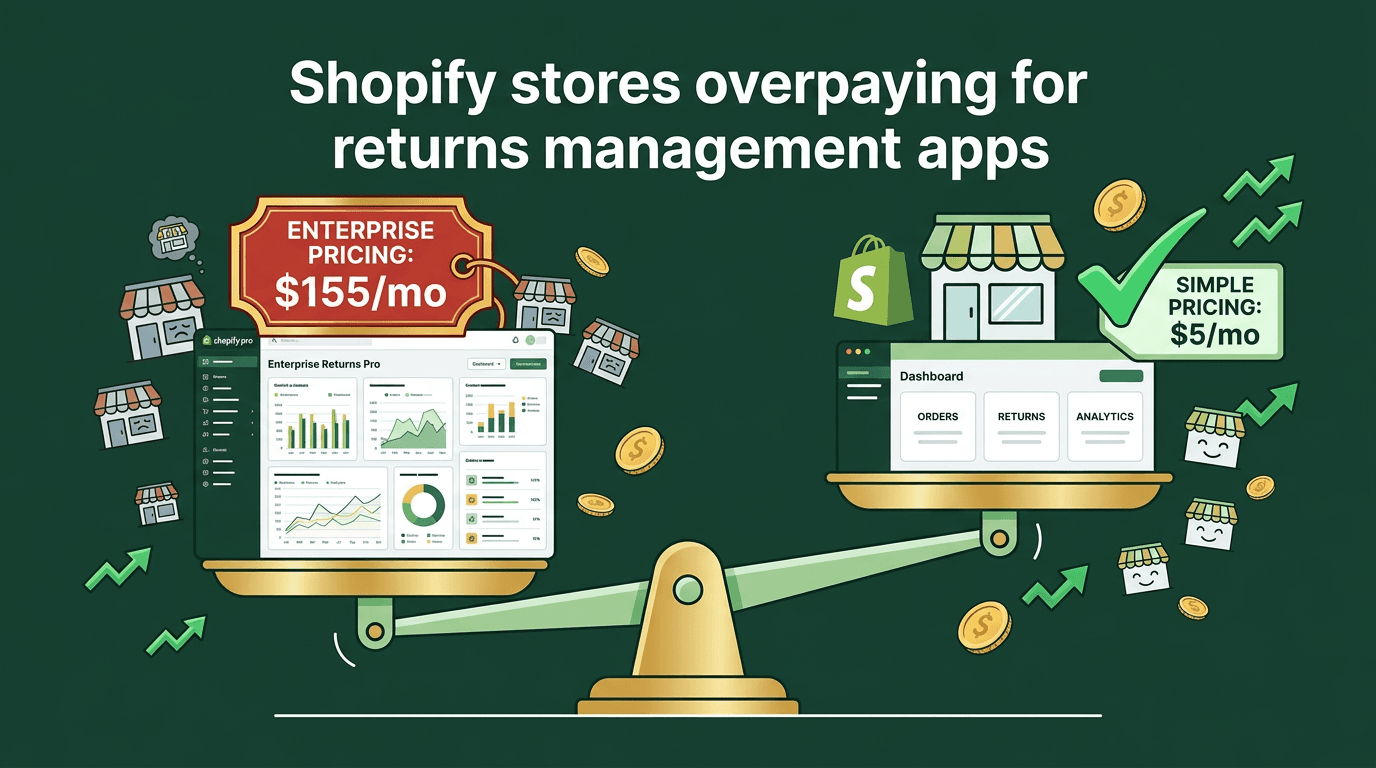
Why Most Shopify Stores Overpay for Returns Management — And What to Do About It
Returns apps charging $100-$200/month are built for enterprise. Here's what small and mid-size Shopify stores actually need — and how to avoid paying for features you'll never use.