Why Most Shopify Stores Overpay for Returns Management — And What to Do About It
Returns apps charging $100-$200/month are built for enterprise. Here's what small and mid-size Shopify stores actually need — and how to avoid paying for features you'll never use.
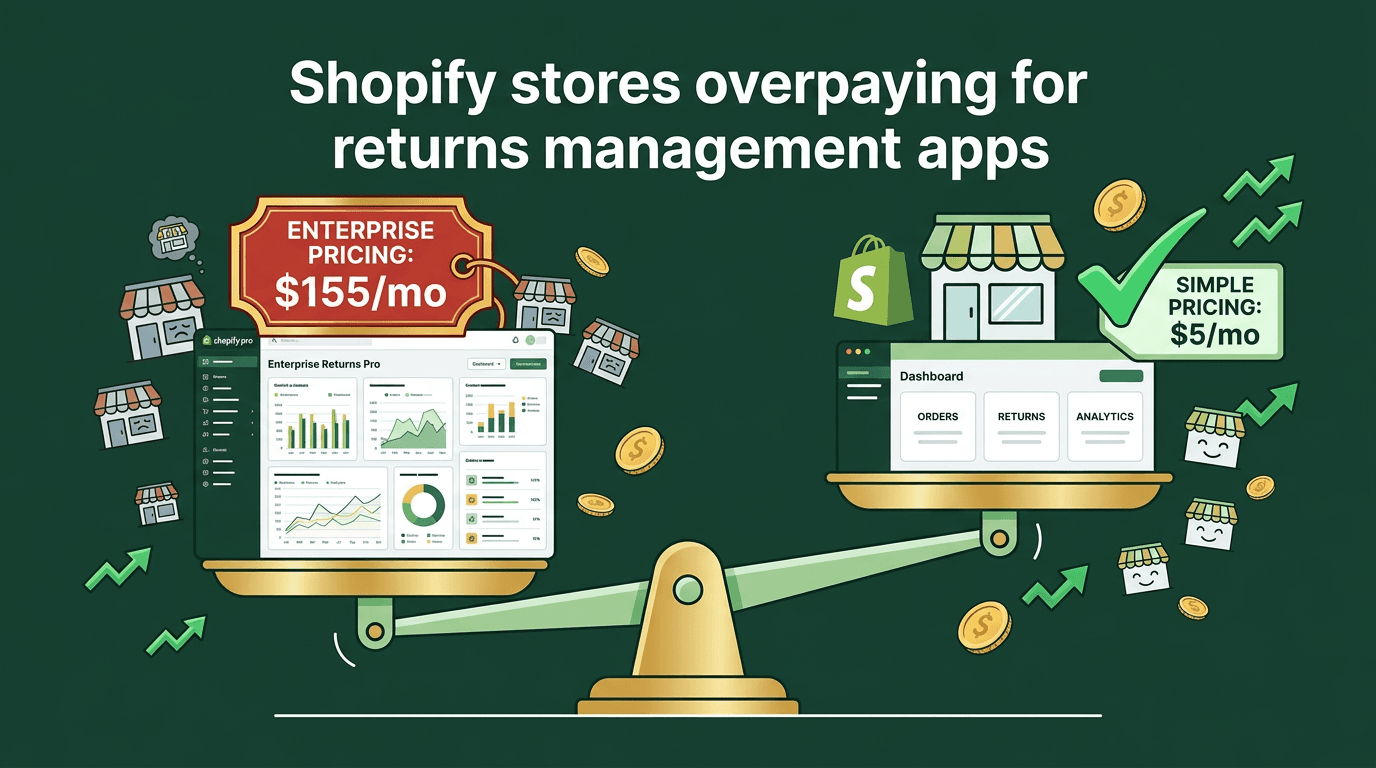
The returns app pricing problem
Open the Shopify App Store, search "returns and exchanges," and you'll find over 120 apps competing for your attention. The top-reviewed options share a common trait: they're expensive.
Loop Returns starts at $155/month. ReturnGo begins at $121/month. AfterShip's advanced plan runs $239/month. These are serious tools built for serious operations — multi-warehouse routing, advanced analytics dashboards, API integrations with third-party logistics providers, white-labeled return portals with custom CSS.
But here's the question nobody asks: does a Shopify store processing 20, 50, or even 200 returns per month actually need any of that?
For the vast majority of Shopify merchants — the ones doing $10K to $500K in annual revenue — the answer is no. And the gap between what they're paying for and what they're using represents one of the most common sources of unnecessary overhead in e-commerce operations.
The frustration is showing up everywhere. A recent Reddit thread titled "LOOP RETURNS ALTERNATIVE" captured it directly: "I'm exploring other returns app options that are more affordable and reliable. Could you recommend any alternatives to Loop?" The replies point to PostCo, Navidium (at just $0.40 per return), and EcoReturns — all at a fraction of the enterprise price. This pattern repeats across the r/shopify subreddit with near-monthly "best returns app?" threads, most concluding that smaller stores don't need the premium tools.
What enterprise returns tools are actually selling
Premium returns apps earn their pricing through features designed for high-volume, multi-channel operations. Here's what that typically includes:
- Multi-warehouse return routing: Automatically directs returns to the nearest warehouse based on inventory needs and geography. Essential if you have 5+ fulfillment locations. Irrelevant if you have one.
- Advanced analytics and BI dashboards: Cohort analysis, return reason breakdowns by SKU, revenue impact modeling, exportable reports for board presentations. Valuable at scale. Overkill for a team of three.
- Third-party logistics integrations: Direct API connections to returns processing centers, refurbishment vendors, and liquidation platforms. Critical for brands processing thousands of returns monthly. Unnecessary for most.
- White-label portal with custom development: Fully branded return experience with custom CSS, JavaScript hooks, and API access for headless storefronts. A nice-to-have that most stores never customize beyond uploading a logo.
- Dedicated account management: A named account manager, quarterly business reviews, custom onboarding. Part of what you're paying for at $155+/month.
None of these features are bad. They exist because large brands with complex operations genuinely need them. The problem is that they're bundled into the base price, which means a store doing $30K/month pays the same rate as a store doing $3M/month.
What small and mid-size stores actually need
Strip away the enterprise features and the core requirements for most Shopify stores are remarkably straightforward:
A simple admin portal
Process exchanges and returns from within Shopify admin or a clean interface that doesn't require training. Your team should be able to handle a return in under two minutes, without switching between tabs or learning a complex dashboard.
Customer self-serve (optional but impactful)
Let customers initiate their own return or exchange request through a portal on your site. This reduces support emails by 40–60% and naturally increases exchange rates because customers see product alternatives during the process.
Exchange-first flow
The ability to present exchanges and store credit before refunds. As we covered in our guide to exchange-first strategy, this single capability can retain 30–40% more revenue from returns. It doesn't require machine learning or predictive analytics — just thoughtful UX.
Return label generation
Generate prepaid return shipping labels without leaving the app. Integration with major carriers (USPS, UPS, FedEx, or Shippo) covers this requirement for 95% of stores.
Basic tracking and notifications
Know where each return stands (requested, shipped, received, resolved) and send automated email updates to customers. Not a real-time analytics dashboard — just status tracking that keeps everyone informed.
That's it. Five capabilities. Everything else is a nice-to-have that doesn't justify doubling or tripling your monthly cost.
The real cost of over-tooling
Overpaying for returns management isn't just about the subscription fee. There are hidden costs that compound:
Complexity tax
Enterprise tools come with enterprise complexity. More features mean more settings, more configuration options, and more things that can break. A store owner who spends two hours per month troubleshooting their returns app workflow is spending time that could be used on marketing, product development, or customer outreach.
Onboarding drag
Complex tools require training. When you hire a new team member, how long does it take them to learn your returns workflow? With a simple tool, the answer is "ten minutes." With an enterprise platform, it's often "a few days plus a training call with the vendor."
Feature bloat paralysis
When your returns dashboard has 47 configuration options, you end up touching none of them. The "we'll set that up eventually" features sit idle month after month while you pay for them. Simpler tools force you to focus on the actions that actually move revenue: getting exchanges processed quickly and keeping customers happy.
Lock-in pressure
The more deeply integrated an enterprise tool becomes with your operations, the harder it is to switch — even when you realize you're overpaying. Migration costs, data portability concerns, and the fear of disrupting existing workflows keep merchants stuck in contracts they've outgrown (or never grew into).
A framework for choosing the right tool
Instead of comparing feature lists, start with your actual operational reality:
Under 100 returns/month
You need a clean admin interface, basic exchange flows, and optional customer self-serve. You do not need multi-warehouse routing, advanced analytics, or API access. Your budget should be $5–$20/month. At this volume, every dollar spent on returns tooling should directly reduce manual work or increase exchange rates.
100–500 returns/month
Self-serve becomes essential at this volume — you can't manually email every customer. Automated label generation and status notifications save meaningful time. Basic return reason analytics help you identify product issues. Budget: $20–$50/month.
500+ returns/month
This is where enterprise features start earning their keep. Multi-location routing, detailed analytics, custom workflows, and logistics integrations become operational necessities rather than nice-to-haves. Budget: $100+/month is justified if the features map to real workflow needs.
The key principle: match the tool to the volume. A store processing 30 returns per month has no business paying $155/month for a returns platform, regardless of how impressive the feature set looks in a demo.
What merchants who switched say
The pattern in merchant reviews tells a consistent story. Stores that move from enterprise-priced tools to right-sized solutions consistently highlight the same themes:
"We tried many other apps built for simplifying returns management and in most cases we were massively overpaying and forced to accept tradeoffs we didn't like. ExchangeIt is easy to learn, easy to train staff on, and does its job well. The price is a great value — you're not overpaying for features you don't care about."
"This is the only app we need to manage all exchanges. Simple and effective, with all the subtle functionality needed. Significantly lowers manual intervention and makes it easy for both sides of the transaction."
"The standard point of sale exchange process for Shopify works great for POS. For online orders, however, Shopify doesn't even have a standard process. We now do 100% of our online exchanges through ExchangeIt."
The common thread isn't about lacking features — it's about having exactly the right features, without the overhead of everything else.
The frustration with Shopify's native exchange handling makes third-party apps more necessary — not less. In a 123-comment Shopify Community thread, merchants discovered that Shopify's returns system treats every return as a refund in analytics — even exchanges and store credit. One merchant reported that Shopify support's response was to suggest moving to a different platform entirely. Another wrote: "We don't pay high monthly subscription fees to have incorrect information... Please have the development team fix this or we will be finding other platforms." When the platform itself can't handle basic exchange accounting, the right third-party app isn't a luxury — it's a necessity. The question is just how much you should pay for one.
The pricing landscape in 2026
Here's how the Shopify returns app market breaks down by price tier:
| Tier | Monthly Cost | Target Store Size | Examples |
|---|---|---|---|
| Budget | $5–$20 | Under 100 returns/month | ExchangeIt ($4.99–$19.99), Navidium ($0.40/return) |
| Mid-range | $20–$100 | 100–500 returns/month | Return Prime, Yanet, PostCo, EcoReturns |
| Enterprise | $100–$300+ | 500+ returns/month | Loop ($155), ReturnGo ($121), AfterShip ($239) |
The budget tier isn't "cheap" in the pejorative sense. It's right-sized. A $4.99–$19.99/month tool that handles exchanges, returns, self-serve, and label generation covers 80%+ of what most Shopify stores need. The remaining 20% are enterprise features that only matter at enterprise scale.
How to evaluate whether you're overpaying
Run this quick audit on your current returns setup:
- List every feature your returns app offers. Most enterprise plans include 20+ distinct capabilities.
- Highlight the ones you've used in the last 90 days. Be honest. "Set up during onboarding but never touched again" doesn't count.
- Calculate your cost per return. Monthly subscription divided by monthly returns processed. If you're paying $155/month for 40 returns, that's $3.88 per return just in software costs — before shipping, labor, and inventory impact.
- Compare against a simpler alternative. Would a $9.99/month tool handle those same 40 returns with the features you actually use? If yes, you're leaving $145/month — $1,740/year — on the table.
Right-sizing your returns stack
E-commerce margins are tight enough without paying for returns infrastructure you don't need. The best returns tool isn't the one with the longest feature list — it's the one that matches your operational reality, processes exchanges quickly, and stays out of your way.
For the majority of Shopify stores, that means a focused tool that does the core job well: process exchanges and returns with minimal friction, for both merchants and customers, at a price that makes sense for the volume.
ExchangeIt was built for exactly this use case. A simple admin portal, optional customer self-serve, exchange-first flows, and integrations with Shippo and Shopify's native tools — starting at $4.99/month with a 7-day free trial. No enterprise contracts. No feature bloat. Just returns management that works.
Your returns tool should cost less than the revenue it saves you. For most stores, that bar is much lower than the industry's enterprise-priced incumbents would have you believe.
Related Articles

Your Back-to-School Return Policy Is a Conversion Lever
Back-to-school 2026 shopping runs online and starts in June. Here's why your back-to-school return policy decides whether parents buy shoes and apparel from you.

TikTok Shop Returns: Get Your Shopify Exchange Flow Ready
TikTok Shop hits $23.4B in US sales in 2026. Social commerce return rates run higher, so here's how to ready your Shopify returns and exchange flow.
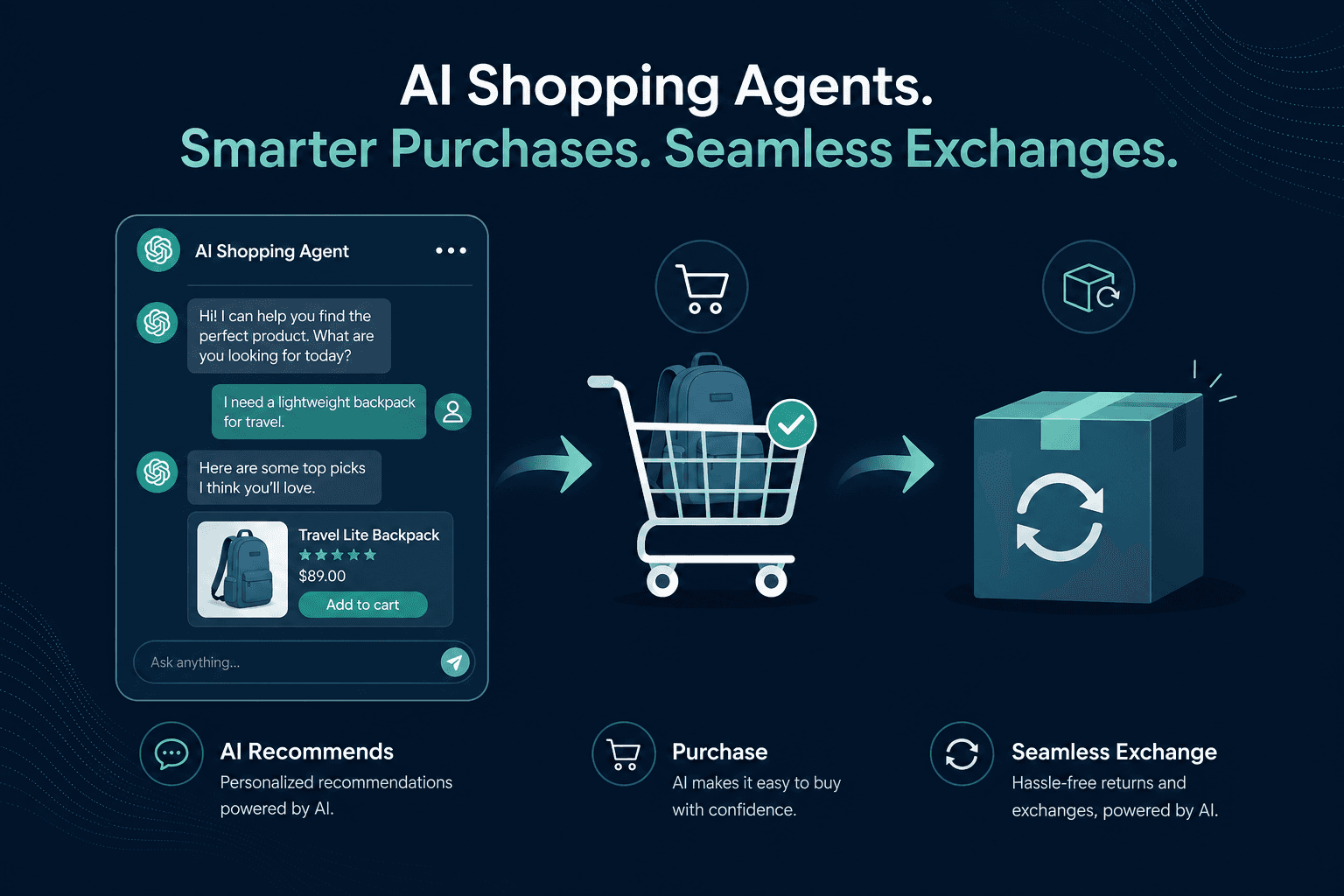
How Agentic Commerce Is Changing Returns and Exchanges for Shopify Merchants
AI-attributed Shopify orders grew 15x in one year. Here's what the rise of agentic commerce means for your returns and exchange strategy.