How to Turn Shopify Returns Into Revenue With an Exchange-First Strategy
Learn why leading Shopify stores are shifting from refund-first to exchange-first return flows — and how to retain 30-40% more revenue from every return request.
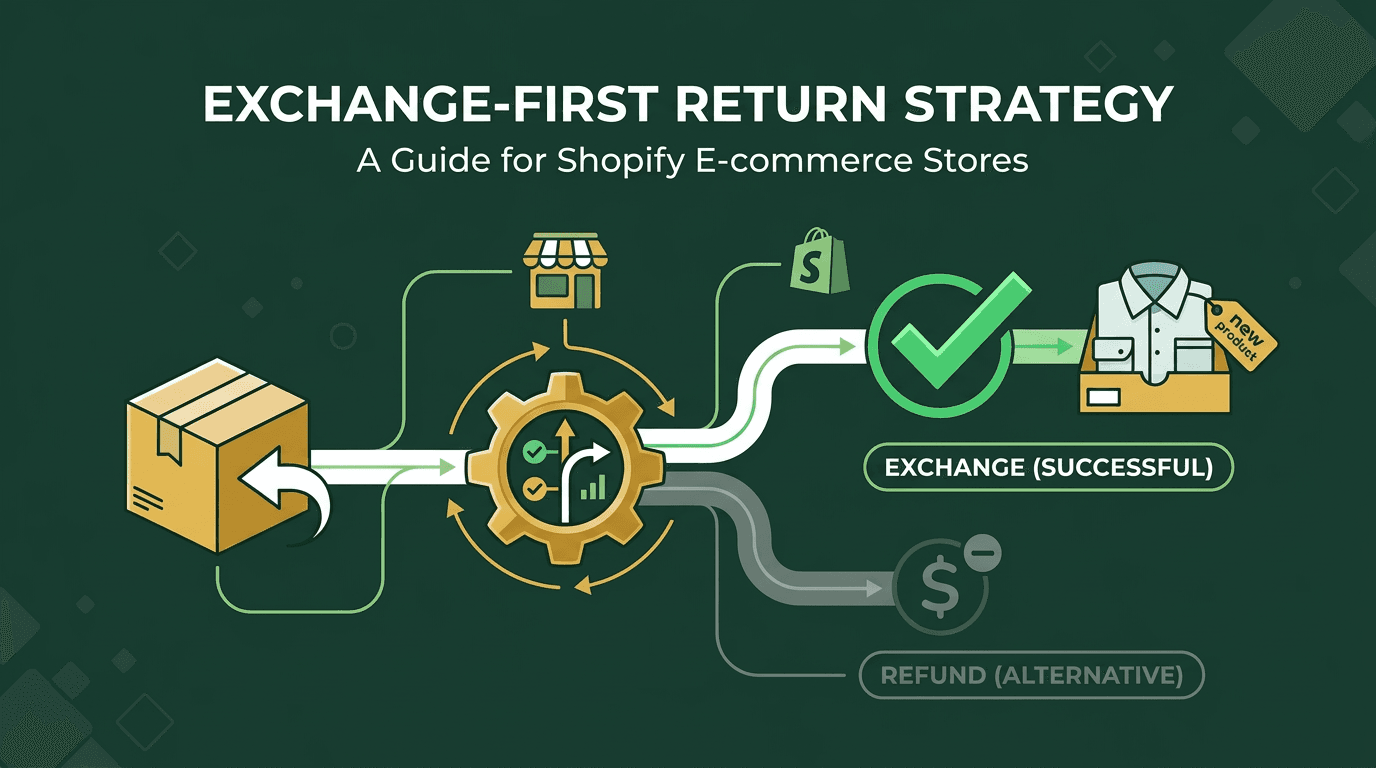
The hidden cost of refund-first returns
Here's a number that should keep every Shopify merchant up at night: the average e-commerce return rate sits between 20% and 30%. For apparel, it climbs to 25–40%. That means for every $100,000 in sales, you could be processing $20,000 to $40,000 in returns.
But the real problem isn't the returns themselves — it's what happens next. Most Shopify stores still default to a refund-first workflow. Customer initiates a return, merchant processes a refund, money leaves the business. Transaction fees? Non-refundable. Shipping costs? Gone. Customer lifetime value? Reset to zero.
The math is brutal. The National Retail Federation forecast a 15.8% return rate in 2025, totaling nearly $850 billion across retail. Each refund costs $10–$20 in logistics alone, plus the 2.9% + $0.30 in Shopify payment processing fees you'll never recover — even if the customer refunds within minutes of purchasing. And only about 30% of returned merchandise can be resold at full price — the rest gets discounted or liquidated.
Making matters worse, Shopify's own analytics system treats every return as a refund in your sales data — even when the customer exchanges or takes store credit. A widely-discussed thread in the Shopify Community (123+ comments, 221 likes) captures the merchant frustration perfectly: "We do more exchanges than returns and I couldn't understand why my sales were so abysmal recently... I've been hitting the panic button on my advertising, all because my net sales in Shopify shows absurdly low (and inaccurate) numbers." If your analytics are lying to you about revenue, every downstream decision — budgeting, forecasting, ad spend — gets distorted.
There is a better way.
What exchange-first actually means
An exchange-first return flow doesn't eliminate refunds. It reframes the decision. Instead of presenting "return for refund" as the default, you design the experience to guide customers toward exchanges, store credit, or product swaps before they reach the refund option.
This isn't about making refunds harder to find. It's about making exchanges easier and more attractive. The distinction matters — both for customer satisfaction and for your bottom line.
When a customer exchanges instead of refunding, you retain 100% of the original sale revenue. The customer keeps a product. Your relationship continues. Compare that to a refund, where you lose the sale, eat the logistics costs, and have to spend 5x more to re-acquire that customer.
The psychology behind exchange-first
Exchange-first strategies work because of a few well-documented psychological principles:
Primacy bias
People tend to select one of the first options presented to them. When your return portal lists "Exchange for a different size" and "Exchange for a different product" before "Request a refund," more customers choose an exchange. It sounds simple because it is — and the data backs it up consistently across Shopify stores of every size.
Loss aversion
Customers who've already made a purchase have a psychological attachment to the transaction. Offering a bonus — "Exchange for $50 in product, or refund for $50 in cash" — frames the refund as the losing option. Add a store credit bump ("Get $55 in store credit instead of a $50 refund") and you tap into the same principle even more effectively.
Friction asymmetry
Make exchanges a one-click process and refunds a three-step process, and behavior follows. This doesn't mean burying the refund option or violating consumer rights. It means investing in the exchange UX so it's genuinely faster and more convenient — free exchange shipping, instant processing, smart product recommendations.
Five tactics to implement exchange-first today
1. Offer free shipping on exchanges only
This is the single most powerful lever. Charge a small flat fee ($5–$8) for refund return shipping, but make exchange shipping completely free. Customers respond to the concrete incentive, and the economics work in your favor because you're retaining the full order value.
2. Add a store credit bonus
Offer 10–15% bonus value when customers choose store credit over a cash refund. A "$50 refund or $57.50 in store credit" offer converts a surprising number of customers — and keeps the money in your ecosystem for a future purchase.
3. Present smart product recommendations
When a customer initiates a return because of sizing or color issues — which accounts for 60% of all Shopify returns — show them the right alternative immediately. If they're returning a Medium, surface the same product in Small and Large. If it's a color issue, show what's in stock. Eliminate the guesswork that leads customers to default to refunds.
4. Enable instant exchanges
Ship the replacement item immediately when the exchange is requested, without waiting for the original to arrive back. Place a hold on the customer's card as collateral. This eliminates the "gap" period where customers are without the product and might reconsider the purchase entirely. Stores that implement instant exchanges see significantly higher exchange completion rates.
5. Automate the entire flow
Manual email-and-phone-call exchanges are the enemy of conversion. Every back-and-forth is an opportunity for the customer to give up and request a refund instead. A self-service portal where customers can select their exchange product, confirm the swap, and get a shipping label in under two minutes is the goal.
This is where tools like ExchangeIt make a measurable difference — giving Shopify merchants a streamlined admin portal and optional customer self-serve that eliminates the friction that kills exchanges.
The revenue math: why this matters at every scale
Let's walk through a realistic scenario for a mid-size Shopify store:
- Monthly revenue: $100,000
- Return rate: 25% ($25,000 in returns)
- Current exchange rate: 15% of returns ($3,750 retained)
- Refund rate: 85% of returns ($21,250 lost)
Now implement an exchange-first strategy and move your exchange rate from 15% to 35% — which is well within the 30–40% range that returns management apps consistently report:
- New exchange rate: 35% of returns ($8,750 retained)
- New refund rate: 65% of returns ($16,250 lost)
- Monthly revenue recovered: $5,000
- Annual impact: $60,000
That's $60,000 per year in revenue retained, not from new customer acquisition or marketing spend, but from customers you've already paid to acquire. For stores doing $500K or $1M+ annually, the numbers scale proportionally.
What your return policy should actually say
Your return policy is a conversion tool, not just a legal document. 67% of shoppers read it before purchasing. Here's what an exchange-first policy communicates:
- Return window: 30 days is standard. Extending to 60 days can actually reduce returns (the "endowment effect" — customers grow attached to products over time).
- Exchange shipping: Free, always. Make this prominent.
- Refund shipping: Small flat fee, or deducted from refund amount.
- Store credit: Available instantly, with a bonus percentage.
- Refunds: Available upon request, processed within 5–7 business days.
The order matters. List exchanges first, store credit second, refunds third. Don't hide anything — just lead with the options that benefit both you and your customer. For a deeper dive, check our guide on how to write an e-commerce exchange policy.
Measuring what matters
Once you've implemented an exchange-first flow, track these metrics monthly:
- Exchange rate: Percentage of returns that become exchanges. Target: 30–40%.
- Revenue retained: Dollar value of exchanges + store credit issued. This is your north star.
- Return rate: Total returns as a percentage of orders. Exchange-first doesn't always reduce this, but it changes the composition dramatically.
- Customer repeat purchase rate: Customers who exchange are far more likely to buy again than those who refund.
- Time to resolution: How quickly exchanges are processed. Faster = higher completion rate.
What the industry is doing about returns fraud
Exchange-first isn't just about revenue retention — it also reduces your exposure to returns fraud, which is an escalating problem. Everlane, the sustainable apparel brand, recently revealed that AI-powered fraud detection from Yofi and Happy Returns is stopping $30,000 to $40,000 in fraudulent returns every month. Their system found that 18% of flagged returns were indeed fraudulent, with each caught instance preventing an average of $240 in loss.
While most Shopify stores don't need Everlane-level fraud infrastructure, the principle applies: every refund is an opportunity for fraud. Exchanges — where customers receive a replacement product rather than cash — inherently reduce fraud exposure because the customer still ends up with your merchandise. Exchange-first flows make this your default path.
Start this week, not next quarter
The shift from refund-first to exchange-first doesn't require a six-month platform migration. For most Shopify stores, you can start seeing results within days:
- Reorder your return portal to list exchanges before refunds.
- Add free shipping for exchanges (charge a small fee for refund returns).
- Set up a 10% store credit bonus for non-refund resolutions.
- Install a returns management app that automates the workflow.
ExchangeIt makes this straightforward for Shopify merchants — with a simple admin portal, customer self-serve options, and the flexibility to implement exchange-first flows without the enterprise price tag. Thousands of merchants already use it to save hours on returns while retaining more revenue from every interaction.
Returns will always be part of e-commerce. The question is whether each return is a dead end or a second chance at the sale. Exchange-first makes it the latter.
Related Articles

Returnless Refunds on Shopify: A 2026 Decision Guide
Returnless refunds are going mainstream. Learn when letting a customer keep the item beats a return label, and how to scope the policy on Shopify.
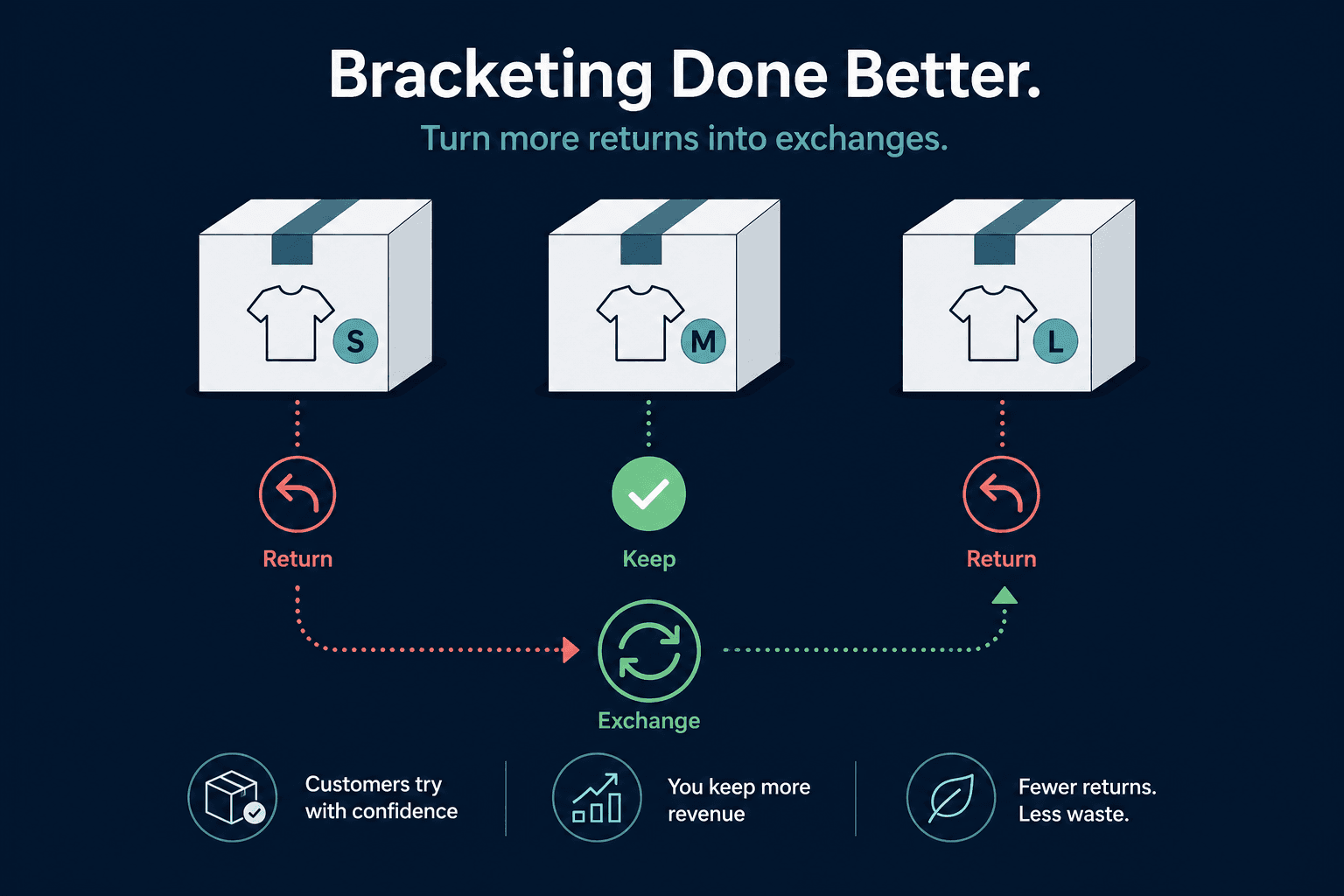
Bracketing Is Costing You Thousands: How to Turn Multi-Item Returns Into Exchanges
63% of shoppers buy multiple sizes to try at home. Learn how to convert bracket returns into exchanges and retain revenue instead of processing refunds.
Refunding With Store Credit: A Game Changer For Your Returns
Discover how offering store credit as a refund option can improve customer retention, reduce revenue loss, and transform your Shopify returns experience.