Bracketing Is Costing You Thousands: How to Turn Multi-Item Returns Into Exchanges
63% of shoppers buy multiple sizes to try at home. Learn how to convert bracket returns into exchanges and retain revenue instead of processing refunds.
The shopping behavior that's quietly draining your margins
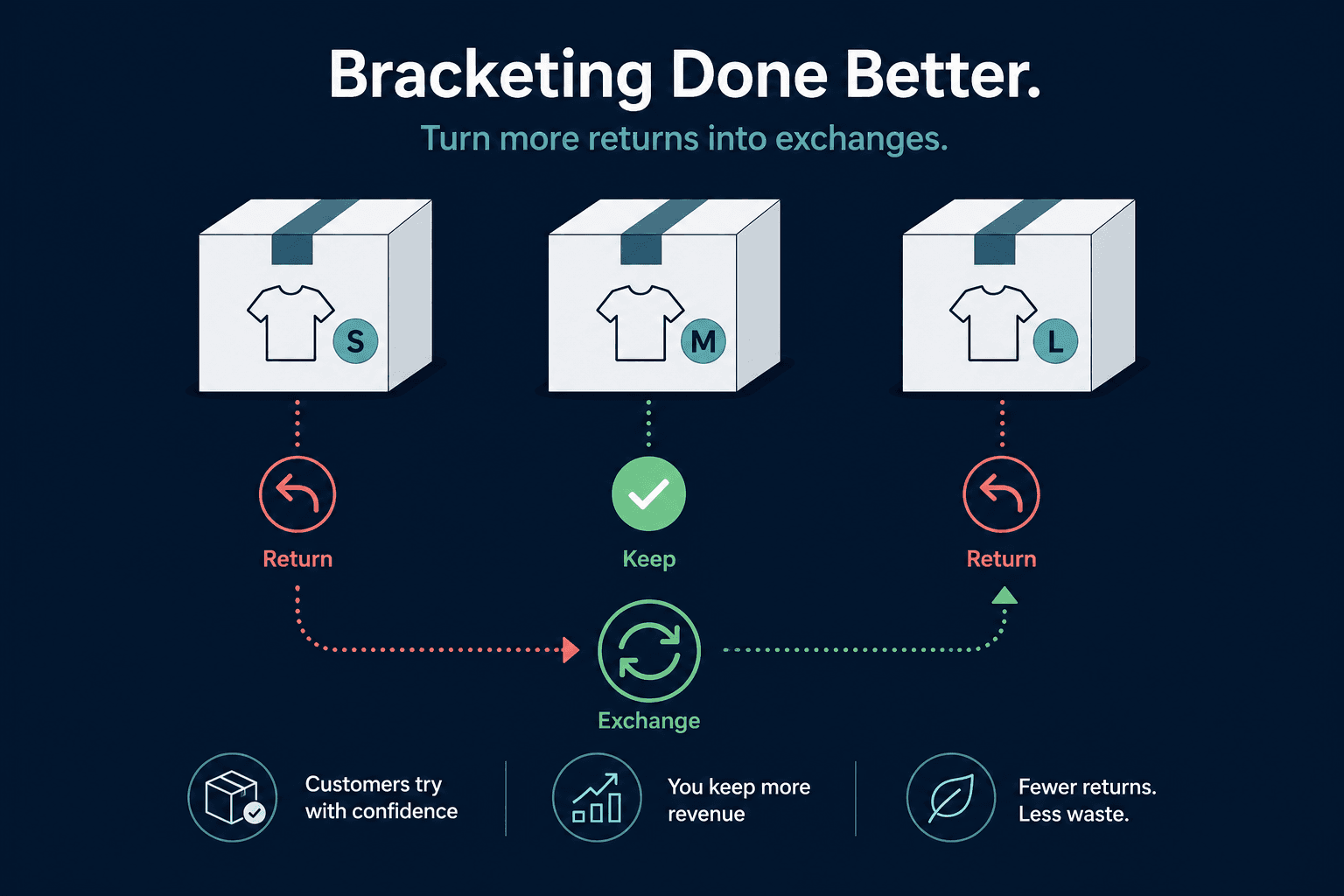
There's a shopping behavior so common that most merchants don't even recognize it as a problem. It's called bracketing: buying multiple sizes, colors, or styles of the same product with the intent to keep one and return the rest. According to Narvar's consumer survey, 63% of online shoppers admit to doing this. And the trend is accelerating: that number was 40% in 2017, jumped to 58% in 2021, and hit 63% in 2022.
For Shopify merchants, bracketing creates a predictable and expensive cycle. A customer orders three sizes of the same sweater. Two come back. You process two return shipments, inspect two items, restock two units, and refund two transactions. The customer got what they wanted. You absorbed the cost of what amounts to a private fitting room, subsidized entirely by your margins.
The real numbers behind bracketing
Bracketing isn't a fringe behavior. The NRF / Happy Returns 2025 Retail Returns Landscape report (surveying 2,006 consumers and 358 ecommerce professionals) found that 23% of all purchases include a bracketed item, rising to 26% in apparel and footwear. That's nearly one in four orders generating a guaranteed return before the package even ships.
The generational split is dramatic. NRF's 2024 report found that 51% of Gen Z shoppers bracket their purchases, compared to just 24% of Baby Boomers. Gen Z also leads in return volume, averaging 7.7 online returns per year, more than any other generation. As Gen Z's buying power grows, so does the bracketing problem.
The financial impact compounds quickly. Pitney Bowes found that returns cost US online retailers an average of 21% of order value, covering shipping, handling, inspection, restocking, and payment processing fees. For a bracketed order where two out of three items come back, you're paying that 21% cost twice on a single customer transaction.
A quick example
Say you sell $80 sweaters. A customer brackets three sizes ($240 order). They keep one, return two. Your return cost on each item is roughly $16.80 (21% of $80). That's $33.60 in return processing for one customer interaction, plus the payment processing fees on two refunded transactions that Shopify doesn't return. The customer paid $80. You spent $33.60 getting there.
Why punishing bracketing backfires
The instinct is to crack down: restrict returns, shorten windows, charge restocking fees on every return. But the data on restrictive policies is clear, and it points in the opposite direction.
The NRF / Happy Returns 2025 survey found that 82% of consumers say free returns are an important consideration when making a purchase (up from 76% the prior year). Even more telling: 71% say they are less likely to shop with a retailer again after a poor returns experience, and four out of five will share that negative experience with friends and family.
Restricting returns to combat bracketing is like locking your front door and boarding up the windows. It keeps the bracketers out, but it keeps everyone else out too. The merchants gaining ground are taking a smarter approach: they're not trying to stop bracketing. They're converting bracket returns into exchanges.
The exchange opportunity hiding inside every bracket return
Here's a data point that changes the entire calculus. Returnalyze found that the keep rate for bracketing is above 75%. That means shoppers who bracket typically keep more than one item. They're not returning everything; they're finding products they like, often in unexpected ways.
This is the insight most merchants miss. A customer who brackets is not a lost cause. They're actively engaged with your products, trying things on, making decisions. When they return the items that didn't work, you have a brief window to redirect that engagement toward an exchange rather than a refund.
Exchange vs. refund: the revenue math
When a bracketing customer returns two items and gets refunds, you lose $160 in revenue (from our $80 sweater example) and absorb $33.60 in processing costs. Net result: $80 in retained revenue minus $33.60 in costs.
When that same customer exchanges one of those items for a different product (say, a matching scarf or a different style), you retain $160 in revenue and process only one return. That's $160 minus roughly $16.80 in costs. The difference in retained revenue is significant, and the customer leaves with two products instead of one.
This is the principle behind an exchange-first return strategy, and it's particularly powerful for bracket returns because the customer has already demonstrated interest in multiple products from your store.
Five tactics to convert bracket returns into exchanges
1. Surface smart recommendations at the point of return
When a bracketing customer initiates a return for the "wrong size," don't just process the refund. Show them the right size, in stock, ready to ship. If they're returning a color they didn't love, show them what else is available. The closer you can get to replicating the fitting room experience digitally, the more bracket returns convert to exchanges.
2. Offer free shipping on exchanges (and charge for refund returns)
This is the single most effective lever for shifting behavior. Make exchanges free and fast; add a small flat fee ($5-$8) for refund return shipping. The data on asymmetric shipping policies is consistent: customers respond to concrete financial incentives, and the economics work because you're retaining the order value.
3. Add a store credit bonus for keeping the revenue in-house
Offer 10-15% bonus value when a customer chooses store credit over a cash refund. A customer returning an $80 sweater can choose between an $80 refund or $90 in store credit. Many will take the credit, especially if they were already browsing your store for a replacement.
4. Enable instant exchanges without waiting for the return
Bracket returns are time-sensitive. The customer already has the item they want to keep; they just need to get rid of the extras. If you make them wait for the return to arrive and be processed before shipping the exchange, you lose the window. Instant exchanges (ship the new item as soon as the return is initiated, don't wait for the old item to arrive) keep the momentum going and dramatically increase exchange conversion rates.
5. Use return data to identify bracketers and personalize outreach
Not all bracketers are the same. Some buy two sizes every time. Others bracket colors. Some bracket across product categories. Tracking these patterns lets you personalize the return experience. A customer who always returns the larger size could see a proactive sizing recommendation on their next purchase ("Based on your history, we'd suggest the Medium"). That's not restricting returns; it's improving the shopping experience for your most engaged customers.
Don't confuse bracketing with fraud
It's important to draw a clear line between bracketing and return fraud. Bracketing is a legitimate shopping behavior driven by the fundamental limitation of online retail: you can't try things on before you buy. Close to two-thirds of consumers admit to at least one costly returns behavior, and 45% believe "bending the truth" is acceptable when making returns, according to the NRF 2025 report. But bracketing itself is not dishonest; it's a rational response to uncertainty.
The merchants who conflate bracketing with abuse end up penalizing their best customers. Remember: bracketers are buyers. They're placing larger orders, engaging with multiple products, and (according to Returnalyze) keeping more than they planned to return. Treat them as high-engagement customers who need a better post-purchase experience, not as a problem to be eliminated.
The bigger picture: $849.9 billion in returns, and growing
Bracketing doesn't exist in isolation. US retail returns are projected at $849.9 billion in 2025, with an estimated 19.3% of online sales returned. Consumers expect speed (76% prefer return options with instant refunds or exchanges), convenience (84% prefer box-free, label-free returns), and flexibility.
The brands that thrive in this environment aren't the ones fighting returns. They're the ones making returns work harder for their business. And for bracketed orders specifically, the exchange is the single highest-leverage tool you have: it keeps the customer, retains the revenue, and turns a cost center into a relationship-building touchpoint.
Turn bracket returns into retained revenue
Exchange It helps Shopify merchants convert returns into exchanges with smart product recommendations, configurable restocking fees, store credit bonuses, and free exchange shipping. Whether your customers are bracketing sizes, comparing colors, or trying new categories, Exchange It makes it easy to keep the sale instead of processing a refund. Set up in minutes, and start retaining revenue from your very next return request.
Related Articles

The Environmental Cost of Returns (and Tighter Policies)
83% of retailers tightened return policies last year. Here's the environmental cost of returns that tightening ignores, and what to do instead.

Returnless Refunds on Shopify: A 2026 Decision Guide
Returnless refunds are going mainstream. Learn when letting a customer keep the item beats a return label, and how to scope the policy on Shopify.
Refunding With Store Credit: A Game Changer For Your Returns
Discover how offering store credit as a refund option can improve customer retention, reduce revenue loss, and transform your Shopify returns experience.