Returnless Refunds on Shopify: A 2026 Decision Guide
Returnless refunds are going mainstream. Learn when letting a customer keep the item beats a return label, and how to scope the policy on Shopify.

Returnless Refunds Went Mainstream While Most Merchants Were Looking Elsewhere
Ask a shopper whether they have ever been told to keep an item and get their money back anyway, and three out of four will say yes. That is a returnless refund, and it is far more common than most Shopify merchants assume.
Narvar's consumer research found that 75% of shoppers report experiencing a "keep the item" refund at least once, most often from Amazon, Walmart, Target, Wayfair, Chewy, Kohl's and Shein. Shopify now publishes its own guidance on returnless refunds, and cites research showing roughly a third of retailers already offer them, with another 28% planning to.
The context is a returns bill that keeps growing. The National Retail Federation and Happy Returns put total 2025 US retail returns at $849.9 billion, or 15.8% of annual sales, with 19.3% of online sales coming back. For a small Shopify store, that is not an abstraction: it is a stack of parcels you paid to ship out, paid to ship back, and paid someone to open.
This guide is a decision framework, not a cheerleading piece. Returnless refunds are a margin tool with a real abuse surface, and the merchants who win with them are the ones who scope them tightly.
The Break-Even Math Behind a Returnless Refund
The single question that decides everything is simple: does getting this item back leave you better off than not getting it back?
Industry estimates put the fully loaded cost of processing a return at roughly $10 to $20 per item once reverse shipping, inspection, restocking and markdowns are counted, and Shopify's enterprise team notes that return logistics and processing can run as much as 65% of the sale price on low-value goods.
Shopify's own worked example uses a $40 item. A traditional return costs you the $40 refund plus an $8 return label, $5 in restocking labor and $10 in inventory loss, for $63 all in. The returnless version costs you the $40 refund and nothing else. You keep $23 by doing less work.
Shopify frames the test as a formula worth stealing:
Net recovery = (resale value minus refurbishment costs) minus (reverse shipping plus labor fees). If the result is negative, you are paying to lose money.
There is a useful second framing here if you already charge return fees. A restocking fee is a partial recovery of processing cost, typically 10% to 25% of the item price. A returnless refund is the opposite end of the same dial: you waive 100% of the fee and skip the shipping cost entirely, because the item was never worth recovering in the first place. Both are answers to the same question about who absorbs reverse-logistics cost.
Run the numbers on your own catalog before you run the policy. Pull your last hundred returns, tag each one with its landed return cost and its actual resale outcome, and you will usually find a clear price band below which recovery never pays.
When Returnless Refunds Beat a Return Label
Narvar's data suggests most retailers are already concentrating this on cheap goods: 59% of "keep the item" refunds were for items under $20, though nearly 20% were for items over $50, which tells you loyalty is also part of the calculation.
Shopify's guidance points to three categories where a returnless refund is usually the right call:
- Low-value accessories. Phone cases, cables, socks, small household add-ons under about $30, where the label alone eats a quarter of the item price.
- Low-margin or bulky items. Furniture components, decor and anything where dimensional shipping weight kills the economics in both directions.
- Consumables and no-resale goods. Opened beauty, hygiene, supplements, pet food or single-use kits that you would legally or practically have to destroy on arrival anyway.
Retail Minded founder Nicole Leinbach Reyhle put the pattern plainly in Shopify's guide:
"I believe returnless refunds will begin to become more prominent for lower-priced items and items that do not always make sense to ship back due to cost or inconvenience."
The mirror image matters just as much. Keep the traditional return for premium electronics (high recovery value, high fraud exposure), for apparel and footwear (recovery rates are good and try-on abuse is rampant), and for seasonal or limited-run stock that you need back on the shelf while it still sells.
Defect-driven returns are the other clean case. If a customer received a cracked ceramic mug, asking them to box it and drive to a carrier location so you can throw it away yourself is a cost with no upside and a customer-experience penalty attached.
The Sustainability Case for Skipping the Return Trip
Reverse logistics is not carbon neutral. One expert estimate cited by AP News suggests returning an item can increase its environmental impact by up to 30%, once you add the second van trip, the extra packaging and the disposal of goods that never make it back to sellable stock.
A returnless refund removes that trip entirely. When the product still works, it also keeps the item in circulation rather than in a landfill: the customer can use it, gift it or donate it.
The messaging matters more than the mechanic. Shopify recommends adding a short "keep, gift, or donate" line to the refund confirmation email, with a link to local donation options where it makes sense. Chewy has built genuine brand affection out of exactly this move, routinely telling customers to donate pet food to a local shelter rather than shipping it back.
Framed that way, a returnless refund stops sounding like you gave up on the item and starts sounding like a deliberate, better outcome. That is a meaningful difference in how the email lands.
The Fraud Risk: Why Returnless Refunds Need Tight Scoping
Here is the caveat that gets glossed over in most coverage. A returnless refund is, structurally, a promise to send money without receiving anything, and that is exactly the shape of transaction fraudsters look for.
The NRF and Happy Returns report that 9% of all returns are fraudulent and that 45% of shoppers consider it acceptable to "bend the rules" when returning items. NRF's asset protection team adds that 39% of Gen Z shoppers surveyed admitted to returning a decoy item instead of the original.
Shoppers themselves see the risk. In Narvar's research, 53% of shoppers worried that "keep the item" policies would be abused, even though only 5% admitted they would take advantage personally.
Merchants feel the same tension. In a Shopify Community thread on implementing a returnless refund policy, the merchant's question was not whether the idea worked but how to build it "to avoid returns from customers who might take advantage of it, but also I would like to provide an excellent customer service." That is the whole design problem in one sentence.
Amazon's approach is instructive because it is boring and mechanical. A return has to pass three filters to qualify: the item cannot be hazardous, recalled, a gift card or heavy and bulky; it generally has to have an average sales price under $75; and the buyer cannot have a history of return abuse.
Borrow that structure. Sensible guardrails for a Shopify store look like this:
- A hard price ceiling, set per category rather than store-wide. Something like $25 for lightweight accessories and a higher ceiling only where shipping genuinely dominates.
- An eligibility list, not a blanket rule. Name the SKUs or collections that qualify instead of opening the policy to your whole catalog.
- A customer-history check. First-time buyers and accounts with repeat return activity should not auto-qualify.
- A frequency cap. One returnless resolution per customer per window, after which the flow reverts to a standard return.
- A quiet policy. Most large retailers do not advertise returnless refunds as an entitlement. They offer them at the point of resolution.
That last point is the one merchants most often get wrong. A publicly advertised "you can keep it" policy invites the exact behavior you are trying to price out. Treat it as a resolution you offer, not a right customers claim. Our guide to combatting return fraud goes deeper on detecting the patterns that should disqualify an account.
How to Scope Returnless Refunds in Your Shopify Returns Workflow
Shopify's native returns tooling handles refunds, exchanges and store credit well, but a "refund without a return" is not a first-class object in the standard flow. Most merchants running this policy assemble it out of return rules and resolution options in their returns app rather than flipping a single switch.
With Exchange It, the pieces you would use are the ones already built for scoping and non-standard resolutions:
- Custom resolutions. Beyond the standard refund, store credit and exchange paths, return rules support a custom resolution option and an exchange-via-note option. Those are what let you record a non-standard outcome, including one where no item comes back, with the reasoning attached to the request.
- Non-returnable item filtering. You can exclude specific products or categories from the standard return flow, which is the same lever that lets you carve out a set of SKUs handled differently from everything else.
- Market-based product filtering. Rules can differ by region. This matters more than it sounds: an international return where the label costs more than the product is the clearest returnless case in most catalogs.
- Per-line-item restocking fees. Configure recovery on the items worth recovering, and leave the low-value tail alone.
- Native store credit. Credit is issued through Shopify's own store credit ledger and refunds process through Shopify's native refund APIs, so nothing sits in a parallel balance you have to reconcile by hand.
To be clear about what this is: Exchange It does not ship a one-click "returnless refund" toggle. What it gives you is enough rule-level control to scope which orders, products and markets get a non-standard resolution, and a place to record it consistently so your reporting does not go blurry.
One adjacent option deserves a mention. A returnless refund does not have to be a cash refund. Offering the item plus store credit instead of the item plus cash keeps the customer whole, keeps the money in your business, and costs you less than a return label plus a refund would have. Our post on refunding with store credit covers the retention math.
Whatever you decide, write it down. A vague policy is where disputes come from, and our guide to writing an ecommerce exchange policy covers how to document resolution options without inviting abuse.
Run It as a Pilot, Not a Policy Change
The lowest-risk way to test returnless refunds is the way Shopify suggests: pick your worst SKUs, the low-margin, high-return-cost items where recovery clearly does not pay, and run a 30-day pilot.
Track four things over that window: total return processing cost, repeat purchase rate among customers who got the returnless resolution, the rate at which those customers file another return, and support ticket volume on those orders. If cost drops and repeat rate holds, expand the eligibility list. If the repeat-return rate spikes, you scoped too loosely.
Narvar's own guidance is that this works best when it is targeted rather than universal, used to recognize existing relationships instead of broadcast to everyone. The company notes that 90% of customers who received a "keep the item" offer had already shopped with that retailer before.
Returnless refunds are not generosity. They are an admission that some items cost more to recover than they are worth, and a decision to spend the difference on customer goodwill instead of freight. Scoped carefully, they cut cost, cut waste, and close returns faster than any label ever will.
Ready to build the rules behind it? Install Exchange It and configure return rules, custom resolutions, market-specific filtering and per-item restocking fees from one place. Plans start at $4.99 per month with a 7-day free trial, and unlimited returns plus the customer portal and store credit are included from the $9.99 Standard plan up. See the full plan comparison to find the right fit.
Related Articles

The Environmental Cost of Returns (and Tighter Policies)
83% of retailers tightened return policies last year. Here's the environmental cost of returns that tightening ignores, and what to do instead.
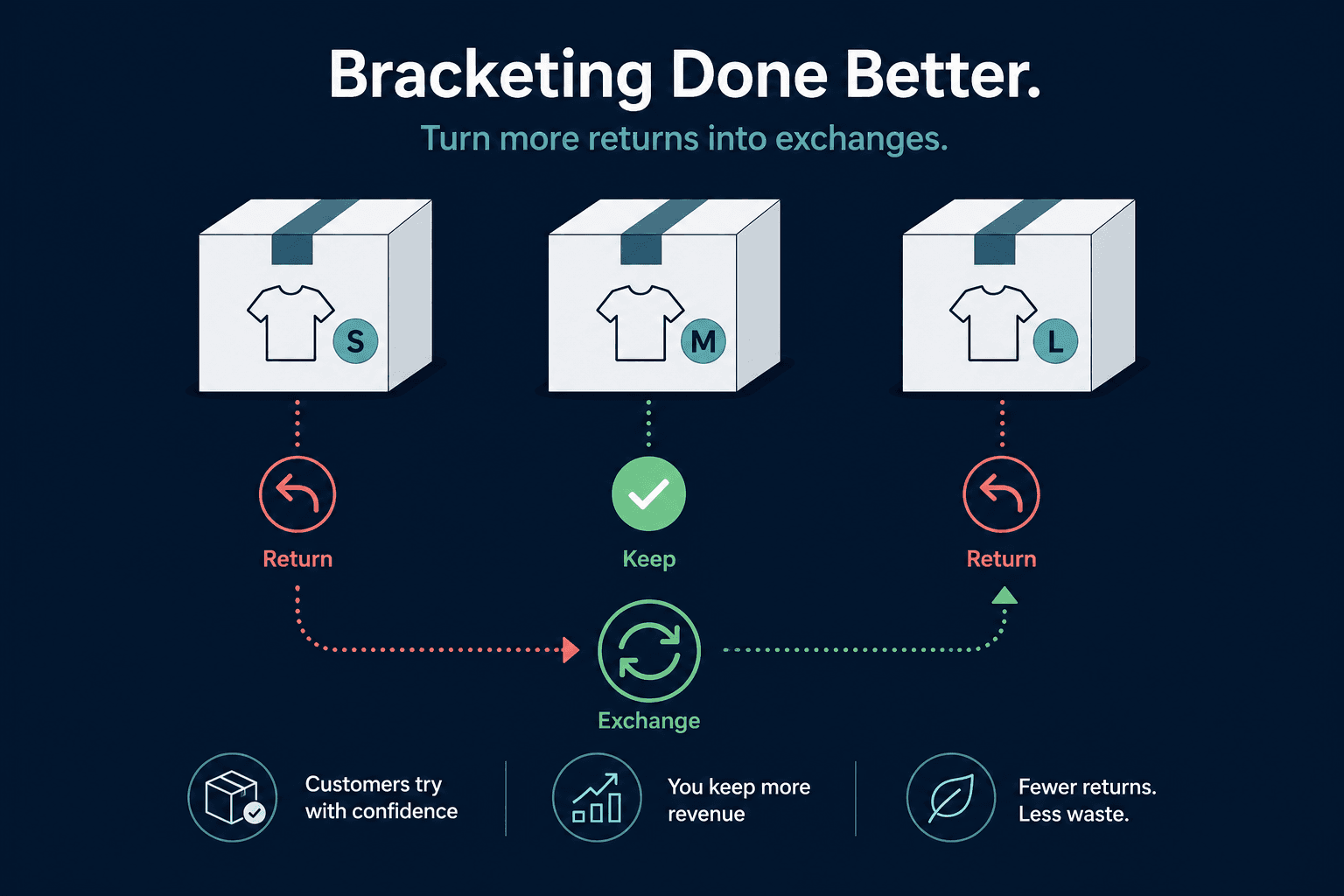
Bracketing Is Costing You Thousands: How to Turn Multi-Item Returns Into Exchanges
63% of shoppers buy multiple sizes to try at home. Learn how to convert bracket returns into exchanges and retain revenue instead of processing refunds.
Refunding With Store Credit: A Game Changer For Your Returns
Discover how offering store credit as a refund option can improve customer retention, reduce revenue loss, and transform your Shopify returns experience.